

2026 Hyundai Tucson Hybrid vs. Toyota Rav4 Hybrid: Which is Better for Spokane Valley Commuters?
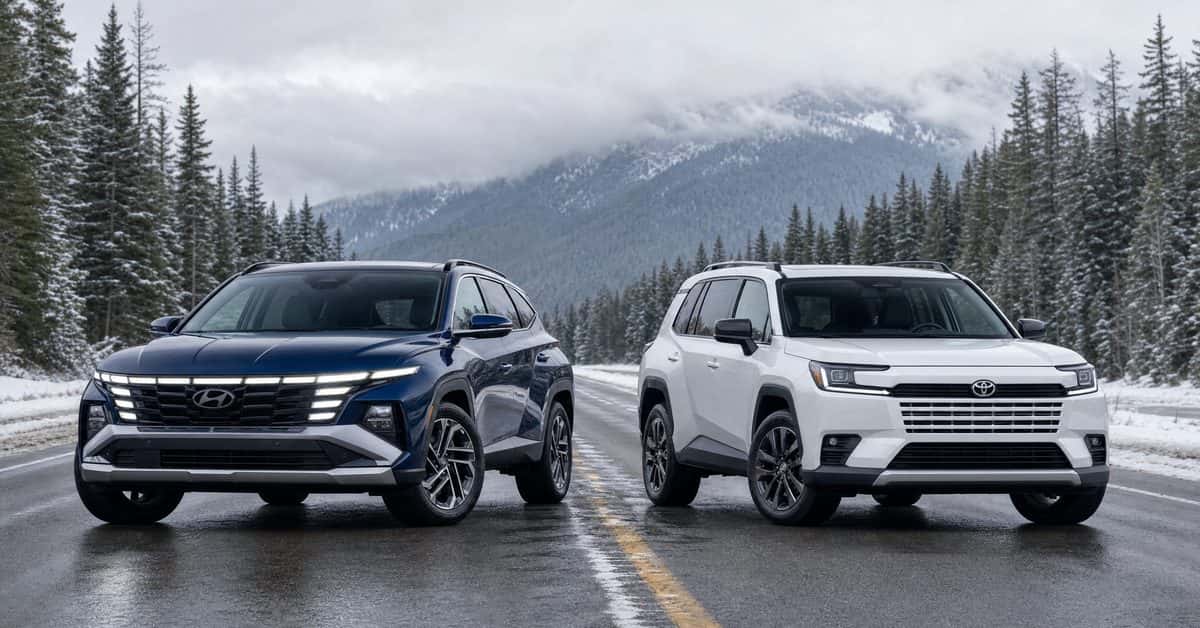
2026 Hyundai Tucson Hybrid (left) vs 2026 Toyota Rav4 Hybrid (right) – compared for Spokane Valley and CDA commuters
If you are shopping for a compact hybrid SUV in the Spokane Valley area, two names come up consistently: the 2026 Hyundai Tucson Hybrid and the 2026 Toyota RAV4 Hybrid. Both are well-regarded compact hybrid SUVs with AWD capability and strong real-world reputations. But for commuters traveling between Spokane Valley, Liberty Lake, Post Falls, and Coeur d’Alene, the differences between these two vehicles matter in ways that go beyond a simple spec sheet comparison.
This guide compares the Tucson Hybrid and RAV4 Hybrid across the factors that matter most to Inland Northwest drivers: fuel economy on I-90, winter AWD capability, standard safety technology, warranty coverage, cabin technology, and total ownership value. The goal is to help you make a confident decision before visiting the dealership — or before scheduling a test drive to experience both on roads that resemble your actual commute.
Bottom line upfront: The Hyundai Tucson Hybrid offers a longer powertrain warranty, standard HTRAC AWD across all trims, and a more comprehensive standard safety suite — advantages that are particularly relevant for Spokane Valley commuters who depend on one vehicle year-round.
← Back to: Why Hyundai Hybrid SUVs Make Sense for Spokane Valley and CDA Commuters
Quick Comparison: 2026 Tucson Hybrid vs. 2026 RAV4 Hybrid
MSRP figures are approximate base prices for the lowest AWD trim of each model and exclude freight, tax, title, and license fees. Fuel economy figures are EPA estimates for comparison purposes; actual mileage will vary. Warranty terms subject to conditions and limitations — see dealer for complete details.
Fuel Economy on I-90: How the Numbers Play Out for Spokane Commuters
On paper, the RAV4 Hybrid edges out the Tucson Hybrid in EPA fuel economy on its lowest AWD trim — 40 combined MPG versus 38 combined MPG for the Tucson Hybrid Blue SE HTRAC AWD. That is a real difference, and it is worth acknowledging honestly. For a driver who covers 12,000 miles per year at $3.50 per gallon, the two-MPG gap translates to roughly $50–$70 in annual fuel savings in favor of the RAV4 Hybrid.
However, the real-world picture is more nuanced for Spokane Valley commuters. The Tucson Hybrid’s 38 combined MPG figure applies to its base AWD trim. Higher Tucson Hybrid trims are rated at 36 combined MPG on HTRAC AWD — still competitive with the RAV4 Hybrid’s upper trims, which also see MPG decline as trim level increases. Both vehicles deliver meaningful efficiency gains over comparable gas-only compact SUVs, which typically average 28–32 combined MPG.
For a driver making the Spokane Valley to Coeur d’Alene commute — roughly 30 miles each way — the hybrid advantage over a gas SUV is meaningful regardless of which model you choose. The more important question for most buyers is whether the other ownership factors (warranty, safety tech, cabin comfort, and monthly payment) tip the balance toward one vehicle or the other.
AWD in Spokane Winters: HTRAC vs. RAV4 Hybrid AWD
Both the Tucson Hybrid and RAV4 Hybrid come standard with AWD on all trims — an important baseline for Spokane Valley shoppers who do not want to pay extra for winter traction capability. However, the two AWD systems work differently, and those differences can matter on Inland Northwest roads.
Hyundai’s HTRAC AWD system uses an electronically controlled coupling to distribute torque between the front and rear axles based on driving conditions. Hyundai engineers the system to respond proactively to traction changes rather than only reacting after wheel slip is detected. For a commuter navigating a snowy on-ramp near Post Falls or a shaded bridge deck between Liberty Lake and Spokane Valley, that proactive behavior can feel more confident.
Toyota’s Electronic On-Demand AWD system on the RAV4 Hybrid uses a separate rear electric motor to power the rear wheels independently from the front drivetrain. This design has its own advantages — the rear motor can deliver torque very quickly and the system has no mechanical connection between front and rear axles, which simplifies packaging. Both systems are capable winter performers, and both have strong real-world reputations in cold-climate markets.
The practical takeaway for Spokane Valley drivers: both vehicles are well-suited for Inland Northwest winters when paired with quality winter tires. AWD alone does not substitute for appropriate tires, safe speeds, and proper following distance on icy or packed-snow roads.
Warranty: Where Hyundai Has a Clear Advantage
This is one of the most significant differences between the two vehicles for buyers who plan to keep their SUV for several years. Hyundai’s America’s Best Warranty includes a 10-Year/100,000-Mile Powertrain Limited Warranty and a 5-Year/60,000-Mile Basic Limited Warranty. Toyota’s warranty on the RAV4 Hybrid is a 5-Year/60,000-Mile Powertrain Warranty and a 3-Year/36,000-Mile Basic Warranty.
For a Spokane Valley commuter who drives 15,000 miles per year, the Hyundai powertrain warranty covers the vehicle through year six or seven of ownership before expiring at 100,000 miles. The Toyota powertrain warranty expires at 60,000 miles — roughly year four for the same driver. That gap is meaningful for buyers who want long-term confidence in their hybrid powertrain without purchasing an extended warranty.
On hybrid battery coverage specifically, Toyota offers 10 years or 150,000 miles in Washington state, while Hyundai offers 10 years or 100,000 miles. Washington state buyers purchasing a RAV4 Hybrid benefit from the longer Toyota battery warranty. Hyundai’s battery warranty is still competitive and covers most buyers through the typical ownership period, but this is one area where Toyota has an edge for high-mileage Washington commuters.
Warranty terms, coverage, and limitations vary. Washington state buyers should confirm hybrid battery warranty terms with their respective dealers. See HyundaiUSA.com/Assurance and Toyota.com for complete details.
Hyundai SmartSense vs. Toyota Safety Sense 2.5+
Both vehicles include a comprehensive standard safety suite on every trim — a meaningful baseline that means Spokane Valley buyers do not need to step up to a higher trim to get forward collision warning, automatic emergency braking, lane-keeping assist, or adaptive cruise control.
The Hyundai Tucson Hybrid’s Hyundai SmartSense suite includes Forward Collision-Avoidance Assist with Pedestrian, Cyclist, and Junction Turning Detection; Smart Cruise Control with Stop & Go; Lane Keeping Assist; Lane Following Assist; Driver Attention Warning; and Blind-Spot Collision Warning. Junction Turning Detection is a notable feature for urban driving — it can detect oncoming vehicles when turning left at intersections, a scenario that occurs frequently in Spokane Valley retail corridors and CDA intersections.
Toyota’s Safety Sense 2.5+ suite includes Pre-Collision System with Pedestrian Detection; Lane Departure Alert with Steering Assist; Automatic High Beams; Radar Cruise Control with Stop & Go; Lane Tracing Assist; and Road Sign Assist. Both suites are well-regarded by safety organizations and cover the core scenarios most relevant to commuter driving.
The practical difference for most drivers is minimal — both systems perform well in real-world conditions. The Tucson Hybrid’s Junction Turning Detection is a differentiator for urban and suburban driving environments, while Toyota’s Road Sign Assist can be useful for drivers who travel unfamiliar routes between Spokane, Post Falls, and CDA.
Cabin Technology and Everyday Usability
The Tucson Hybrid’s base Blue SE HTRAC AWD trim includes a 12.3-inch touchscreen as standard equipment. The RAV4 Hybrid’s base LE AWD trim includes a 10.5-inch touchscreen, with the larger 12.3-inch display available on XLE and higher trims. For buyers who want the larger screen without paying for a higher trim, the Tucson Hybrid has an advantage at the entry level.
Both vehicles support wireless Apple CarPlay and Android Auto on higher trims. The Tucson Hybrid offers a digital instrument cluster and available heads-up display on upper trims. The RAV4 Hybrid offers a multi-information display and available JBL audio on upper trims. For most commuters, the base technology on both vehicles is sufficient for daily navigation, music, and hands-free calling.
Who Should Choose the Tucson Hybrid?
The Tucson Hybrid is the stronger choice for Spokane Valley commuters who prioritize long-term warranty confidence, standard AWD across all trims, a larger base touchscreen, and a comprehensive standard safety suite. It is especially well-suited for:
- Drivers who plan to keep their vehicle for 6–10 years and want powertrain coverage throughout that period.
- Commuters who travel I-90 between Spokane Valley, Liberty Lake, Post Falls, and Coeur d’Alene and want winter AWD confidence without paying a trim premium.
- Buyers who want the largest standard touchscreen at the lowest AWD entry price.
- Households replacing an older gas SUV who want a familiar refueling experience with hybrid efficiency.
View Tucson Hybrid Inventory Near Spokane Valley →
Who Should Consider the RAV4 Hybrid?
The RAV4 Hybrid is a strong competitor and the right choice for some buyers. It is worth serious consideration for:
- High-mileage Washington state commuters who prioritize the longer Toyota hybrid battery warranty (150,000 miles vs. 100,000 miles).
- Drivers who prioritize maximum EPA-rated fuel economy and the RAV4 Hybrid’s slight MPG advantage on base trims.
- Buyers who have a strong existing preference for Toyota’s reliability reputation and dealer network.
- Shoppers who want Toyota’s specific Road Sign Assist feature for varied-route commuting.
The honest answer is that both vehicles are excellent compact hybrid SUVs. The decision often comes down to warranty preference, monthly payment, and which vehicle feels better on a test drive that resembles your actual Spokane Valley commute.
Total Ownership Value: The Warranty Factor
For many Spokane Valley buyers, the most compelling reason to choose the Tucson Hybrid over the RAV4 Hybrid is not a single spec — it is the combination of competitive pricing, standard AWD, and a powertrain warranty that is twice as long as Toyota’s. An extended warranty purchased separately for a RAV4 Hybrid can add $1,500–$3,000 to the total cost of ownership. The Tucson Hybrid includes that coverage as standard.
For a commuter who drives 13,000–15,000 miles per year and keeps their vehicle for 7–8 years, the Hyundai powertrain warranty covers the full ownership period. The Toyota powertrain warranty expires around year four. That difference is real money and real peace of mind, particularly for a hybrid powertrain that some buyers are still evaluating for the first time.
Schedule a Tucson Hybrid Test Drive at Spokane Hyundai →
Financing and Trade-In: Making the Switch Accessible
Many Spokane Valley buyers comparing the Tucson Hybrid and RAV4 Hybrid are also trading out of an older gas SUV or sedan. If your current vehicle has strong trade value, the upgrade to a Tucson Hybrid may be more accessible than the sticker price suggests. Getting a trade estimate early in the process helps clarify your actual out-of-pocket cost before you step into the dealership.
Pre-qualifying for financing online is another step that makes the comparison process more efficient. When you know your financing range before visiting, your test drive can focus on the real question: which hybrid SUV feels right for your Spokane Valley commute, your family, and your budget.
Value Your Trade Online → |
Get Pre-Qualified in Seconds →
The Verdict for Spokane Valley Commuters
For most Spokane Valley, Liberty Lake, Post Falls, and Coeur d’Alene commuters, the 2026 Hyundai Tucson Hybrid offers the stronger overall ownership package. It delivers competitive hybrid fuel economy, standard HTRAC AWD on every trim, a 10-Year/100,000-Mile Powertrain Warranty that is twice as long as Toyota’s, a larger standard touchscreen, and a comprehensive Hyundai SmartSense safety suite — all at a comparable entry price to the RAV4 Hybrid.
The RAV4 Hybrid is a legitimate competitor with a slight MPG edge on base trims and a longer hybrid battery warranty for Washington state buyers. If those two factors are your top priorities, the RAV4 Hybrid deserves a test drive as well. But for buyers who want long-term powertrain confidence, standard AWD, and a well-equipped base trim, the Tucson Hybrid is the stronger value for Inland Northwest commuting.
Ready to see the 2026 Hyundai Tucson Hybrid in person?
View Tucson Hybrid Inventory →
Schedule a Test Drive →
Value Your Trade →
Get Pre-Qualified in Seconds →
← Read the full Hyundai Hybrid SUV guide for Spokane Valley and CDA commuters
Frequently Asked Questions
Is the Hyundai Tucson Hybrid better than the Toyota RAV4 Hybrid for Spokane winters?
Both the Tucson Hybrid and RAV4 Hybrid come standard with AWD on all trims, making both capable choices for Spokane winters. The Tucson Hybrid uses Hyundai’s HTRAC AWD system, which distributes torque proactively between front and rear axles. The RAV4 Hybrid uses a separate rear electric motor for AWD. Both systems perform well in cold-weather conditions when paired with appropriate winter tires.
Does the Tucson Hybrid have a better warranty than the RAV4 Hybrid?
Yes, for powertrain coverage. The Hyundai Tucson Hybrid includes a 10-Year/100,000-Mile Powertrain Limited Warranty as part of Hyundai’s America’s Best Warranty. The Toyota RAV4 Hybrid includes a 5-Year/60,000-Mile Powertrain Warranty. For hybrid battery coverage in Washington state, Toyota offers 10 years or 150,000 miles, while Hyundai offers 10 years or 100,000 miles. See each dealer for complete warranty terms and limitations.
Which gets better gas mileage — the Tucson Hybrid or RAV4 Hybrid?
The RAV4 Hybrid has a slight EPA fuel economy advantage on its base AWD trim — 40 combined MPG versus 38 combined MPG for the Tucson Hybrid Blue SE HTRAC AWD. On higher trims, both vehicles see MPG decline. The real-world difference for most commuters is modest, and both vehicles deliver meaningful efficiency gains over comparable gas-only compact SUVs.
Is the Tucson Hybrid good for the Spokane Valley to Coeur d’Alene commute?
Yes. The Tucson Hybrid is well-suited for the I-90 corridor between Spokane Valley, Liberty Lake, Post Falls, and Coeur d’Alene. It combines standard HTRAC AWD, 231 combined horsepower, hybrid fuel economy, and Hyundai SmartSense driver-assistance features — a practical combination for a commute that includes freeway driving, winter conditions, and mixed stop-and-go traffic.
Where can I test drive a Tucson Hybrid near Post Falls or Coeur d’Alene?
Spokane Hyundai is located at 8801 E Sprague Ave, Spokane Valley, WA 99212 — convenient to Liberty Lake, Post Falls, and Coeur d’Alene via I-90. You can schedule a Tucson Hybrid test drive online or call (509) 944-3600 to check current inventory and availability.
All vehicle specifications, pricing, and fuel economy figures are based on 2026 model year data from Hyundai USA and Toyota USA and are for informational and comparison purposes only. MSRP figures are approximate and exclude freight, tax, title, and license fees. EPA MPG estimates may vary with driving conditions. Warranty coverage subject to terms and limitations; see each dealer for complete details. Hyundai SmartSense and Toyota Safety Sense features are driver-assistance technologies and do not replace attentive driving. AWD does not guarantee safe operation in all conditions.
0 comment(s) so far on 2026 Hyundai Tucson Hybrid vs. Toyota Rav4 Hybrid: Which is Better for Spokane Valley Commuters?